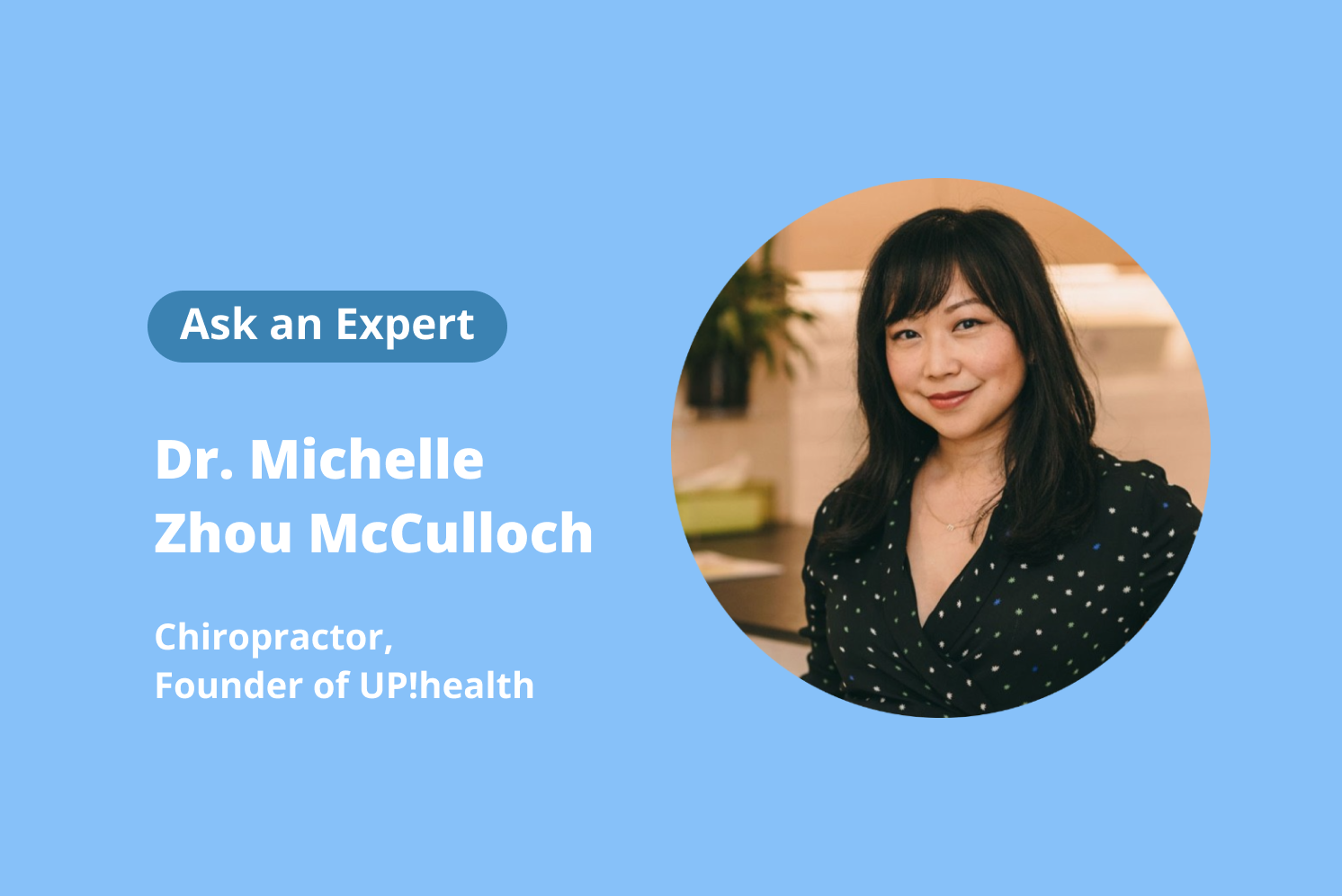
Regularly Finding Ways to Fill Your Cup: Conversations with Dr. Michelle Zhou McCulloch, Founder of UP!health

This week we met with Dr. Michelle Zhou McCulloch, Chiropractor, founder of UP!health, and mom of two (soon to be mom of three!). We chatted about how chiropractic care can help women from pregnancy to postpartum, her own experience with postpartum depression and the importance of seeking help as a new mom. 

Tell us about yourself and your journey to founding UP!health.

My name is Michelle, and I am a chiropractor with over 15 years of experience. I was born in Shanghai and grew up in Australia. I obtained my chiropractic qualifications in Australia and practiced there for a few years before moving to Hong Kong. Eight years ago, I started UP!health as a small clinic with two practitioners. Since then, it has grown into a multi-disciplinary health center with two locations in the heart of Hong Kong’s Central and Admiralty districts.

I see you have many pregnant clients. What are some common pregnancy complaints and how can chiropractic care help alleviate them?

The most common complaint among pregnant women is lower back pain, which affects over 50% of them. The rapid changes that a pregnant woman’s body goes through can cause spinal misalignment, muscle tension, and a general increase in inflammation. One commonly misdiagnosed lower back condition is called sacroiliac joint instability or sprain, which occurs when one of the pelvic joints becomes too unstable due to the growing baby and the hormone relaxin. It can be extremely painful for women during any kind of movement transition. Regular chiropractic adjustments can help alleviate many of the associated pregnancy aches. 

Furthermore, starting from the third trimester, I also help my clients with birth preparation. A well-aligned spine and pelvis will not only help the woman feel better but also lead to better birth outcomes, such as reduced labor time and lower levels of perceived pain.

How does chiropractic care help with postpartum recovery?

Postpartum care has been my passion since I had children myself. I gained a deeper understanding of what women go through during this special and very difficult period, not just physically but also emotionally and psychologically.

Chiropractic care can help with alignment because the first few months of taking care of a newborn can be physically taxing for the body (this also holds true for new dads!). Additionally, during the initial part of the postpartum period, there is still an elevated level of the hormone relaxin, which loosens joints and ligaments. This is, in fact, a golden window of opportunity to correct many underlying alignment problems, which is crucial for overall recovery and better spinal health in the long run.

What’s the golden window of opportunity in terms of getting postpartum chiropractic treatment?

I generally advise vaginal birth mothers to have their first assessment at 4 weeks postpartum, while c-section moms should wait until 6 weeks postpartum. The golden window for chiropractic care is from 4-6 weeks postpartum to around 6 months postpartum. The closer to the birth, the better the corrective effect of chiropractic adjustment. However, there are still benefits to getting chiropractic adjustments beyond the 6-month mark. Many women I see in the clinic have children who are 5 or older and still suffer from associated issues from pregnancy or birth. It is important for all women to get checked after having a baby, regardless of the stage of postpartum you are in.

Just out of curiosity, what postpartum treatments did you seek yourself?

My #1 treatment is of course, chiropractic care! Like hairdressers, chiropractors can’t adjust themselves. I relied on my wonderful colleagues at UP!health for my postpartum chiropractic care. #2 is seeing a pelvic floor specialist (like a women’s physiotherapist) to make sure my pelvic floor is working properly for me to return back to practice. #3 is hiring a lady to come to my home and cook nutritious postpartum meals, so I know I’m well nourished as I rest, recover and take care of my newborn. 

I understand you had your own struggle with Postpartum Depression (PPD). Do you mind sharing your own experience?

I’m very open to sharing this experience, hoping to provide guidance to those who might be going through the same thing. I was diagnosed with PPD 8 months after having my first baby, and it came as a surprise to me! Life as a new mother was very challenging for me. I had many low and tiring days, and I was struggling with my new identity while trying to keep up with my old self for work and business. Initially, all of that stress was expected, and I thought it was “normal.” However, after many months and still feeling very much stuck in the same “funk,” my husband encouraged me to seek professional help in the form of a clinical psychologist. The diagnosis was, in fact, refreshing, and it made sense to me after thinking it through. I had completely lost interest in things that normally brought me joy, and life was busy but mostly going through the motions. My cup was empty, so to speak.

A useful advice I got from my psychologist was to get a 40 min sweaty exercise at least 5 times a week. It helped elevate the level of serotonin in my brain, which is the happy neurotransmitter. Another thing was identifying the things that I was internally struggling with, both from my early life and the transition into motherhood. I worked with my psychologist for around 10 months to slowly feel more like myself again. Healing really takes time. But as long as you are working towards the goal, however small steps you take consistently, it will make a big difference over time. Since recovering from depression, I transitioned my mental health care to regular monthly Kinesiology sessions – it is a form of energy healing and works for me. 

I think self-care comes in many forms, whether it’s a walk in nature, a good laugh with a friend, or a chiropractic adjustment. Everyone will have a different formula. For me, the key is to regularly find ways to fill your cup and be flexible about it. You got this, mama!

Rosalind Bei

A proud mom to two adorable little girls, Rosalind is the founder of Parachute. She started Parachute out of her own frustrations in finding postnatal nannies in Hong Kong. Her vision is to make postpartum help more accessible than ever, so those early parenting days can be filled with more cuddles, confidence and peace. 

Leave a Reply

Your email address will not be published. Required fields are marked *

@parachute on Instagram
[insta-gallery id="1"]

Press ESC to close

This week we met with Dr. Michelle Zhou McCulloch, Chiropractor, founder of UP!health, and mom of two (soon to be mom of three!). We chatted about how chiropractic care can help women from pregnancy to postpartum, her own experience with postpartum depression and the importance of seeking help as a new mom. 

Tell us about yourself and your journey to founding UP!health.

My name is Michelle, and I am a chiropractor with over 15 years of experience. I was born in Shanghai and grew up in Australia. I obtained my chiropractic qualifications in Australia and practiced there for a few years before moving to Hong Kong. Eight years ago, I started UP!health as a small clinic with two practitioners. Since then, it has grown into a multi-disciplinary health center with two locations in the heart of Hong Kong’s Central and Admiralty districts.

I see you have many pregnant clients. What are some common pregnancy complaints and how can chiropractic care help alleviate them?

The most common complaint among pregnant women is lower back pain, which affects over 50% of them. The rapid changes that a pregnant woman’s body goes through can cause spinal misalignment, muscle tension, and a general increase in inflammation. One commonly misdiagnosed lower back condition is called sacroiliac joint instability or sprain, which occurs when one of the pelvic joints becomes too unstable due to the growing baby and the hormone relaxin. It can be extremely painful for women during any kind of movement transition. Regular chiropractic adjustments can help alleviate many of the associated pregnancy aches. 

Furthermore, starting from the third trimester, I also help my clients with birth preparation. A well-aligned spine and pelvis will not only help the woman feel better but also lead to better birth outcomes, such as reduced labor time and lower levels of perceived pain.

How does chiropractic care help with postpartum recovery?

Postpartum care has been my passion since I had children myself. I gained a deeper understanding of what women go through during this special and very difficult period, not just physically but also emotionally and psychologically.

Chiropractic care can help with alignment because the first few months of taking care of a newborn can be physically taxing for the body (this also holds true for new dads!). Additionally, during the initial part of the postpartum period, there is still an elevated level of the hormone relaxin, which loosens joints and ligaments. This is, in fact, a golden window of opportunity to correct many underlying alignment problems, which is crucial for overall recovery and better spinal health in the long run.

What’s the golden window of opportunity in terms of getting postpartum chiropractic treatment?

I generally advise vaginal birth mothers to have their first assessment at 4 weeks postpartum, while c-section moms should wait until 6 weeks postpartum. The golden window for chiropractic care is from 4-6 weeks postpartum to around 6 months postpartum. The closer to the birth, the better the corrective effect of chiropractic adjustment. However, there are still benefits to getting chiropractic adjustments beyond the 6-month mark. Many women I see in the clinic have children who are 5 or older and still suffer from associated issues from pregnancy or birth. It is important for all women to get checked after having a baby, regardless of the stage of postpartum you are in.

Just out of curiosity, what postpartum treatments did you seek yourself?

My #1 treatment is of course, chiropractic care! Like hairdressers, chiropractors can’t adjust themselves. I relied on my wonderful colleagues at UP!health for my postpartum chiropractic care. #2 is seeing a pelvic floor specialist (like a women’s physiotherapist) to make sure my pelvic floor is working properly for me to return back to practice. #3 is hiring a lady to come to my home and cook nutritious postpartum meals, so I know I’m well nourished as I rest, recover and take care of my newborn. 

I understand you had your own struggle with Postpartum Depression (PPD). Do you mind sharing your own experience?

I’m very open to sharing this experience, hoping to provide guidance to those who might be going through the same thing. I was diagnosed with PPD 8 months after having my first baby, and it came as a surprise to me! Life as a new mother was very challenging for me. I had many low and tiring days, and I was struggling with my new identity while trying to keep up with my old self for work and business. Initially, all of that stress was expected, and I thought it was “normal.” However, after many months and still feeling very much stuck in the same “funk,” my husband encouraged me to seek professional help in the form of a clinical psychologist. The diagnosis was, in fact, refreshing, and it made sense to me after thinking it through. I had completely lost interest in things that normally brought me joy, and life was busy but mostly going through the motions. My cup was empty, so to speak.

A useful advice I got from my psychologist was to get a 40 min sweaty exercise at least 5 times a week. It helped elevate the level of serotonin in my brain, which is the happy neurotransmitter. Another thing was identifying the things that I was internally struggling with, both from my early life and the transition into motherhood. I worked with my psychologist for around 10 months to slowly feel more like myself again. Healing really takes time. But as long as you are working towards the goal, however small steps you take consistently, it will make a big difference over time. Since recovering from depression, I transitioned my mental health care to regular monthly Kinesiology sessions – it is a form of energy healing and works for me. 

I think self-care comes in many forms, whether it’s a walk in nature, a good laugh with a friend, or a chiropractic adjustment. Everyone will have a different formula. For me, the key is to regularly find ways to fill your cup and be flexible about it. You got this, mama!

Rosalind Bei

A proud mom to two adorable little girls, Rosalind is the founder of Parachute. She started Parachute out of her own frustrations in finding postnatal nannies in Hong Kong. Her vision is to make postpartum help more accessible than ever, so those early parenting days can be filled with more cuddles, confidence and peace.